
Thousands bought new boats at the 2026 Javits Boat Show. Here's what dealers won't tell you about protecting your Sea Ray or Regal from Long Island's brutal saltwater before it ever launches.
Share:

Summary:
Boat manufacturers build vessels for a national market. That means gelcoat formulations are optimized for average conditions—not the specific challenges of Long Island Sound and the North Atlantic.
Your new Sea Ray or Regal left the factory with a gloss reading between 82-88 on a professional meter. That’s showroom perfect. But factory gelcoat has no enhanced UV inhibitors. No saltwater-specific protection. No molecular barrier against oxidation.
The North Atlantic doesn’t care about factory specs. Salt spray travels inland, affecting boats even at protected marinas. UV rays reflect off water surfaces, doubling exposure. Temperature swings between seasons cause constant expansion and contraction in gelcoat. Within your first season, that 82-88 gloss reading can drop into the 30s. You’ll see chalking, fading, and the beginning of oxidation that only gets worse from there.

The damage timeline for unprotected gelcoat in saltwater environments is faster than most new boat owners expect.
Week 1-2: Salt spray begins depositing microscopic crystals on your gelcoat surface. You won’t see it yet, but it’s there. UV rays start breaking down the chemical bonds in your factory finish at the molecular level.
Week 3-6: You’ll notice water doesn’t bead like it did when the boat was new. That’s your first visible sign that the gelcoat’s protective properties are degrading. Salt deposits become more visible, especially after a day on the water.
Week 7-12: Early-stage oxidation appears. Your gelcoat starts looking slightly dull in direct sunlight. Colors lose some of their depth. This is the point where many owners think a good wax job will fix everything. It won’t. The damage is already happening beneath the surface.
By month four, you’re dealing with visible chalking on horizontal surfaces. The areas that get the most sun exposure—your bow, cabin top, anywhere that faces upward—start showing the telltale signs of UV breakdown. Dark-colored hulls show it faster. That rich blue or deep red you fell in love with at the boat show? It’s already fading.
Here’s the part that frustrates new owners: this isn’t a maintenance issue. You can’t wax your way out of oxidation once it starts. Traditional marine wax lasts weeks, not months, in Long Island’s saltwater. You’d need to wax your boat 4-6 times per season just to maintain basic protection. That’s 16-36 hours of labor annually, plus $2,000-$9,000 in professional detailing costs over five years.
And even with that level of maintenance, you’re not preventing oxidation. You’re just slowing it down. The gelcoat is still deteriorating. The pores are still opening up. The damage is still compounding. When you eventually decide to address it properly, you’re looking at $10,000-$12,000 in professional gelcoat restoration—if the damage hasn’t gone too deep.
Long Island Sound and the surrounding North Atlantic waters create a perfect storm of conditions that accelerate boat deterioration.
Saltwater in Long Island Sound measures around 20,000 mg/L of chloride. That’s full-strength ocean salinity. Salt doesn’t just affect your boat when you’re on the water. It becomes airborne. Marinas throughout Nassau County and Suffolk County deal with salt spray that travels inland, depositing corrosive residue on every boat in the facility.
You’ll find boats stored miles from the water that still show salt damage. That’s because coastal air carries salt particles that settle on surfaces, then attract moisture from humidity. Even boats under covers aren’t fully protected. The salt gets in. It always gets in.
UV exposure in this region is more intense than many new boat owners realize. Water surfaces reflect UV rays back onto your boat, effectively doubling the exposure your gelcoat receives. Your cabin top gets hit from above. Your hull gets hit from reflection off the water. There’s no escape from it when you’re on Long Island Sound.
Temperature extremes add another layer of stress. Your boat experiences expansion and contraction cycles throughout the year. Summer heat causes gelcoat to expand. Winter cold causes it to contract. These constant changes create microscopic stress fractures in the gelcoat surface. Those fractures become entry points for salt and moisture, accelerating the oxidation process from within.
Nassau County and Suffolk County marinas see all of these conditions simultaneously. Your boat isn’t just dealing with salt or just dealing with UV. It’s dealing with both, plus temperature stress, plus humidity, plus the constant cycle of wet-dry-wet that happens every time you use the boat.
This is why boats stored in Arizona or Colorado can maintain their factory finish for years with minimal maintenance, while the same boat on Long Island starts showing wear within months. The environment is fundamentally different. The protection strategy has to be different too.
Want live answers?
Connect with a Legacy Motors & Marine expert for fast, friendly support.
Ceramic coating for new boats isn’t about making your vessel look better. It’s about creating a molecular barrier before oxidation ever starts.
Professional marine ceramic coating bonds directly to your gelcoat at the molecular level. It fills the microscopic pores in the factory finish, then cures into a hard, glass-like layer that becomes part of the surface. This isn’t a coating that sits on top of your gelcoat like wax. It’s a chemical bond that can’t wash off.
The protection is comprehensive. Ceramic coating blocks 99.9% of UV rays from ever reaching your gelcoat. It prevents salt crystallization on the surface. It creates a hydrophobic barrier that makes water, dirt, and grime slide off with minimal effort. And it does all of this for 2-5 years with nothing more than regular washing.
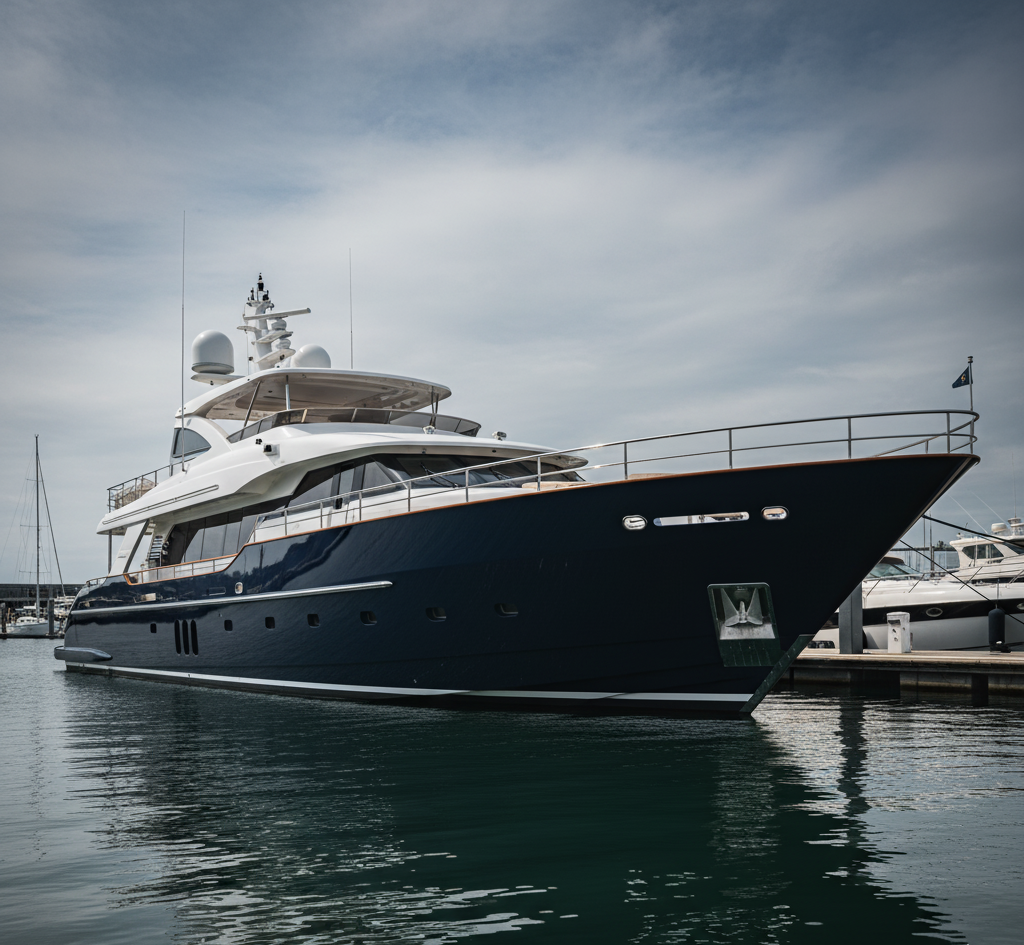
The ideal time to ceramic coat your new boat is before it ever touches saltwater. Here’s why timing makes such a significant difference.
When your boat is still at the dealer or in transit from the factory, the gelcoat is in pristine condition. There’s no salt contamination. No UV damage. No oxidation beginning beneath the surface. Professional ceramic coating applied at this stage bonds to clean, perfect gelcoat. The protection starts immediately, and oxidation never gets a chance to begin.
Compare that to coating a boat after it’s been in a marina for even a few weeks. Now you’re dealing with salt deposits that need removal. Early-stage UV damage that requires correction. Contamination in the gelcoat pores that has to be extracted. The surface preparation becomes more intensive. The results are still excellent, but you’ve already lost the advantage of protecting pristine gelcoat.
Dealers typically want to deliver your boat as quickly as possible. That’s understandable from their perspective. But it creates a narrow window for protection. Once your boat is sitting at a Nassau County or Suffolk County marina, getting it to a facility for proper ceramic coating becomes logistically more complicated. You’re coordinating transport, dealing with marina access, working around weather windows.
The smarter approach: arrange ceramic coating before delivery. Your boat goes from the dealer to our professional application facility, gets properly protected, then arrives at your marina ready for the water. No exposure to salt spray during the vulnerable early period. No UV damage accumulating while you’re trying to schedule protection. No regrets about waiting too long.
This is especially important for boats purchased at the New York Boat Show. You’re buying in January. Your boat might not hit the water until April or May. That’s months of sitting at a marina or storage facility, exposed to salt air and UV rays, before you even start using it. Ceramic coating immediately after purchase means your boat is protected during that entire pre-season period.
The cost difference between pre-delivery coating and post-delivery coating is minimal. The protection difference is substantial. You’re eliminating months of potential damage. You’re ensuring the coating bonds to perfect gelcoat. And you’re starting your ownership experience with the peace of mind that comes from knowing your investment is properly protected from day one.
The other critical pre-delivery consideration is marine electronics customization. This is where many new boat owners make expensive mistakes that could have been avoided with proper planning.
Factory electronics packages are basic. Manufacturers install the minimum viable systems to get the boat functional. But if you’re boating on Long Island Sound, you need navigation systems that account for local conditions. You need fish finders calibrated for the specific depths and structures you’ll encounter. You need communication equipment that works reliably when weather turns rough.
Buying electronics separately and trying to install them yourself—or having different vendors install different components—creates integration nightmares. Your GPS might not communicate properly with your autopilot. Your fish finder might interfere with your VHF radio. Your display units might not share data the way you expected. These aren’t hypothetical problems. They’re common issues that plague new boat owners who piece together systems without professional integration.
Professional marine electronics installation before delivery solves this entirely. Everything gets installed in a controlled environment. All components are tested together to ensure they communicate properly. Wiring is done with marine-grade tinned copper conductors and proper waterproof connections. The entire system is integrated as a cohesive unit, not a collection of individual devices fighting for bandwidth.
This matters more in saltwater environments than most people realize. Long Island Sound’s salt spray corrodes electronics connections aggressively. Improperly sealed connections fail within months. Automotive-grade wire corrodes. Consumer electronics not rated for marine use develop problems quickly. Professional installation using marine-grade components prevents all of these failures before they happen.
The other advantage of pre-delivery electronics customization: you get exactly what you need for your specific boating style. Serious fishing requires different electronics than cruising. Navigation-focused boating needs different systems than watersports. We can design a system that matches your actual use case, not just install whatever the dealer happened to package with the boat.
Coordinating ceramic coating and electronics customization before delivery makes logistical sense too. Your boat is already at our facility being worked on. Both services can happen simultaneously. You’re not making multiple trips or coordinating multiple vendors. The boat arrives at your marina completely finished, fully protected, and ready to use exactly the way you want to use it.
The 2026 New York Boat Show brought thousands of buyers together with boats they’ve been dreaming about. If you’re one of them, you’ve made a significant investment. The question now is whether that investment gets protected properly or whether it starts deteriorating the moment it hits a Long Island marina.
Factory finishes aren’t designed for North Atlantic conditions. Ceramic coating before first launch prevents oxidation from ever starting. Professional marine electronics integration ensures your systems work together flawlessly. Both services are significantly more effective when done before delivery rather than after months of exposure.
This isn’t about adding unnecessary costs to your boat purchase. It’s about understanding what actually happens to boats in saltwater environments and making informed decisions based on that reality. The new boat owners who protect their vessels immediately avoid the restoration costs, maintenance headaches, and value depreciation that come from waiting too long. For Nassau County and Suffolk County boat owners, we provide the expertise and facility to get both ceramic coating and electronics customization done right, before your boat ever sees salt spray.
Article details:
Share:
Continue learning:
