
Before you pick a storage facility — or assume your driveway is fine — here's what Long Island boat owners actually need to know about the rules.
Share:

Summary:
If you’ve been storing your boat in the driveway and assuming that’s fine, you might want to read this first. Long Island has a layered set of rules governing where boats can be stored, who needs permits, and what facilities are actually required to provide — and most of that information is scattered across county codes, town ordinances, and HOA documents that nobody reads until there’s a problem. This guide pulls it together. By the end, you’ll know exactly what applies to you, what questions to ask any storage facility you’re considering, and what separates a genuinely professional operation from a gravel lot with a padlock.
Suffolk County has its own boating safety law — Chapter 325 — that requires all county residents who operate a pleasure vessel on county waters to hold a valid NASBLA-approved boating safety certificate and carry it on board at all times. That certificate can come from the NYS Department of Parks, Recreation and Historic Preservation, the U.S. Power Squadrons, the U.S. Coast Guard Auxiliary, or any other NASBLA-approved course provider. It applies to all Suffolk County residents operating on those waters, regardless of experience level.
Beyond the county-level law, individual towns layer on their own requirements. Brookhaven Town, for example, requires a mooring permit before any mooring tackle goes into harbor waters, and that tackle must meet Town specifications and pass inspection before it’s deployed. If you’re launching from a NYSDEC-managed site anywhere on Long Island, you’ll also need a Managed Land Access Permit — which is free and valid for three years, but still required.

This is the question most Long Island boat owners ask before they ever think about a storage facility. The honest answer is: it depends, and you need to check before you assume.
Many HOA-governed communities on Long Island prohibit boats in driveways outright. Others allow it, but only for a limited window — 24 or 48 hours for loading, cleaning, or maintenance — not as a permanent storage solution. Given how densely developed Nassau County and western Suffolk County are, a significant portion of homeowners live in planned communities where those rules are actively enforced. Even if your HOA allows it, local municipal ordinances may still restrict how long a boat or trailer can sit on residential property, whether it can be parked on the street, and whether it creates a sightline or safety issue at the end of your driveway.
The practical reality for many Long Island homeowners is that driveway storage simply isn’t viable — not because of preference, but because the rules don’t allow it, the lot size doesn’t accommodate it, or both. A 26-foot boat on a trailer takes up the full length of most suburban driveways, leaving nothing for the cars that actually need to park there. A tarp is not the same as proper winter storage.
Coastal humidity, freeze-thaw cycles, UV exposure, and the occasional nor’easter do real damage to vessels left unprotected through a Long Island winter — damage that shows up as cracked through-hulls, corroded electronics, and degraded upholstery by the time spring arrives. If you get a notice from your HOA or a citation from your municipality, that’s usually what drives people to search for professional storage for the first time. But ideally, you’re looking into this before that happens — because the options are better and the timing is on your side when you’re not scrambling.
Not all storage facilities are operating at the same standard, and the per-foot rate you see advertised is rarely the whole picture. Some facilities list a base rate and then add mandatory charges — bottom painting, waxing, jack stand rentals — that only appear in the fine print after you’ve committed. Knowing what to ask upfront saves you from an unpleasant spring bill.
Security is the first thing to evaluate, and it goes well beyond a gated entrance. A quality boat storage facility should have HD video surveillance with night vision capability, motion sensors, controlled access with codes or credentials that are changed regularly, a professional alarm monitoring system, and detailed logs of who enters and exits the facility. They should also carry comprehensive facility insurance — and require proof of your vessel’s insurance before they accept it into storage. That dual-layer protection matters when something goes wrong, whether it’s weather, theft, or accidental damage from a neighboring stored vehicle.
Climate control is the next meaningful differentiator, particularly for luxury vessels and boats with sensitive electronics. A climate-controlled environment regulates both temperature and humidity — it’s not just a heated building. The distinction matters because it’s the combination of temperature swings and coastal humidity that causes the most damage during a Long Island winter: corroded connections, cracked seals, degraded upholstery, and electrical gremlins that don’t show up until you’re already on the water in May.
Beyond security and climate, look at what’s actually included in the storage agreement. Battery tender systems that keep your vessel’s electrical system maintained throughout the off-season mean you’re not dealing with a dead battery every time you want to launch. Optional maintenance checks during the storage period can catch small issues before they become expensive spring repairs. Concierge pickup and delivery means you don’t have to coordinate hauling the boat yourself. These aren’t luxury add-ons — they’re the difference between storage that protects your investment and storage that just parks it.
Want live answers?
Connect with a Legacy Motors & Marine expert for fast, friendly support.
Outdoor storage is the most common and most affordable option for Long Island boat owners, and for many vessels it’s perfectly appropriate — as long as the facility meets a real security and care standard. The key is understanding what outdoor storage actually needs to include to protect your boat through a Long Island winter, and what questions to ask before you sign anything.
A secured outdoor storage yard should have perimeter fencing, controlled access entry, 24/7 surveillance, and live or remote monitoring. If a facility’s main security feature is a padlock on a chain-link fence, that’s not adequate for a vessel worth tens of thousands of dollars. Shrink wrapping is also standard practice for outdoor winter storage — it’s not the same as a tarp, and any facility worth using will either offer it or work with a provider who does.
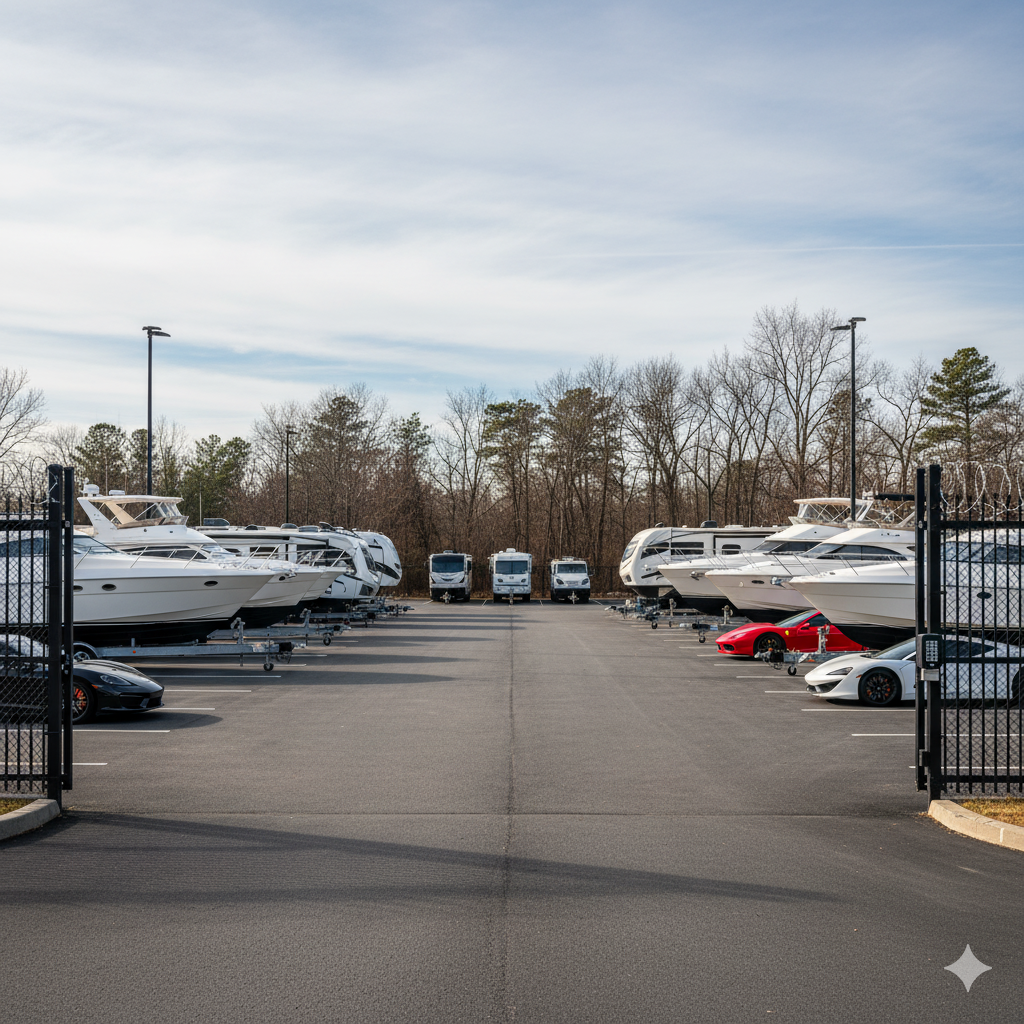
The decision between indoor and outdoor storage usually comes down to three things: the value of the vessel, what’s on board, and how much you want to spend on spring prep.
For boats with sophisticated electronics, high-end upholstery, or finishes that matter to you, indoor climate-controlled storage is the clear choice. Long Island’s winters are genuinely cold, and the combination of freezing temperatures and coastal humidity creates conditions that degrade electrical systems, crack gelcoat, and damage through-hull fittings over time. Indoor storage eliminates that exposure entirely. It also typically means you can skip shrink wrapping, which offsets some of the cost difference between indoor and outdoor.
Outdoor storage makes sense for vessels that are more utility-focused, boats stored on their own trailers, and owners who are comfortable with the standard winterization process — shrink wrap, antifreeze in the engine block and water systems, battery removal or tender connection, and a proper inspection before the boat goes under cover. The important thing is that “outdoor” doesn’t mean “unprotected.” A quality outdoor storage facility is still a secured, monitored, professionally operated yard — not a field with a sign out front.
Long Island’s boating season runs roughly May through October, which means your boat will be in storage for approximately six months of the year. What happens to your vessel during those six months — whether it’s maintained, monitored, and kept in ready condition, or just sitting — has a real impact on what you’re dealing with when you’re ready to launch.
Long Island has no shortage of places willing to take your boat for the winter. The question is which ones are actually set up to protect it.
Start with security documentation. Ask any facility you’re considering to walk you through their surveillance setup, access control system, and insurance coverage. A professionally operated boat storage facility should be able to answer those questions without hesitation. If the answer is vague — “we have cameras” or “it’s fenced in” — that tells you something. The facilities that take security seriously have specifics: HD cameras with night vision, motion detection, controlled access credentials, alarm monitoring, and a log of every entry and exit.
Next, ask about what’s included. Battery tender systems, maintenance checks during the storage period, and concierge pickup and delivery aren’t standard at every facility — but they’re worth asking about, because they change the experience significantly. Knowing your vessel’s battery is being maintained, and that someone will flag a developing issue before it becomes a spring repair bill, is worth a lot more than a slightly lower per-foot rate at a facility that just parks it.
Also ask about the facility’s own insurance and whether they require proof of your vessel’s insurance before accepting it into storage. The best operations require both — their own comprehensive coverage and confirmation that your vessel is insured on your end. That dual-layer requirement is a sign of a professionally run operation, not an inconvenience.
Finally, consider what else the facility can do for you. A boat storage facility that also handles marine detailing, marine electronics installation, and other services under one roof means your vessel can come out of storage already serviced and ready — not waiting on an appointment somewhere else while the season ticks by.
The rules around boat storage on Long Island are more involved than most people expect — between Suffolk County’s boating safety certificate requirement, Brookhaven Town mooring permits, NYSDEC access permits, HOA restrictions, and municipal ordinances, there’s a lot to navigate before you even get to choosing a facility. Understanding what applies to your situation puts you in a much better position to make a smart decision rather than a reactive one.
When you’re evaluating storage options, the facility’s security infrastructure, climate control capabilities, included services, and insurance practices matter far more than the advertised per-foot rate. The right storage keeps your vessel in launch-ready condition all winter — not just parked somewhere until spring.
We at Legacy Motors and Marine serve Nassau and Suffolk County with both indoor and outdoor storage options, and we bring the same standard of care to every vessel we store. If you’re looking for boat storage on Long Island that takes your vessel as seriously as you do, we’re worth a conversation.
Article details:
Share:
Continue learning: