
Not sure whether indoor or outdoor boat storage is the right call? Here's what each option actually does — and doesn't — protect your vessel from.
Share:

Summary:
Every fall, Long Island boat owners face the same question: where does the boat go, and how much protection does it actually need? It sounds simple until you start weighing the options — and realizing that the wrong call can show up as a repair bill in the spring. This isn’t about talking you into the most expensive option. It’s about helping you understand what each storage format actually does, what it leaves exposed, and how Long Island’s particular environment factors into that decision. By the end of this, you’ll know exactly what questions to ask and what to look for.
When most people think about boat storage, they picture two choices: inside a building or outside on a lot. But the reality is a bit more layered than that. Broadly speaking, you’re looking at three formats — fully enclosed indoor storage, covered boat storage, and open outdoor storage — each one offering a different level of protection at a different price point.
Open outdoor storage is exactly what it sounds like: your boat sits on a trailer or jack stands in a secured yard, exposed to whatever the season brings. Covered boat storage sits in the middle — a roof overhead, but open on the sides, which blocks precipitation but not much else. Fully enclosed indoor storage puts your vessel inside a building, with varying levels of climate control depending on the facility.
Understanding these distinctions matters because “indoor storage” isn’t a single product. A basic indoor space with no climate regulation is meaningfully different from a facility that actively manages temperature and humidity. Knowing what you’re actually getting — not just what the sign says — is the starting point for any good storage decision.

Covered boat storage tends to get oversold as a middle-ground solution, and it’s worth being specific about what it does and doesn’t do. A roof overhead will keep rain and snow off your hull and canvas. That’s genuinely useful, and it’s a step up from a tarp staked into the ground. But a covered structure with open sides doesn’t regulate temperature, doesn’t control humidity, and doesn’t stop wind-driven salt air from reaching every surface of your boat.
On Long Island, that last point matters more than it does in most markets. Whether your boat lives on the North Shore near the Sound or you’re launching out of one of the South Shore bays, you’re dealing with a saltwater environment year-round — not just during boating season. Salt air doesn’t take the winter off. It settles into hardware, works into electrical connections, and accelerates corrosion on anything metal that isn’t actively protected. A roof stops the rain. It doesn’t stop any of that.
The other thing covered storage doesn’t address is temperature swing. Long Island winters regularly cycle above and below freezing, sometimes within the same week. That freeze-thaw pattern is hard on fiberglass, hard on through-hull fittings, and particularly hard on any onboard electronics that weren’t fully winterized. A covered structure keeps the snow off the cockpit cover. It doesn’t stabilize the environment your boat is sitting in.
So covered storage has its place — particularly for boats that are well-winterized, lower in value, or being stored for a short window. But it’s not a substitute for enclosed storage when the vessel or the conditions call for something more. It’s a shelter, not a solution.
Climate-controlled storage is the highest tier of indoor storage, and it’s the option that generates the most questions — mostly along the lines of “is it really necessary, or is it just a premium upsell?” The honest answer is that it depends on what’s inside your boat.
For a basic fishing boat with minimal electronics and a hull you’re not planning to sell anytime soon, a clean, enclosed indoor space without active climate control may be perfectly adequate. But for a vessel with sophisticated onboard electronics — GPS, chartplotters, NMEA networks, marine audio systems, fishfinders — the calculus changes significantly. Marine electronics are acutely sensitive to humidity and temperature swings. Condensation forming inside a chartplotter housing over the course of a Long Island winter isn’t a hypothetical. It’s a known failure mode. And replacing that equipment costs considerably more than the difference between standard and climate-controlled storage.
Beyond electronics, humidity is the quiet enemy of marine interiors. Upholstery absorbs moisture. Teak develops mildew. Vinyl cracks when it’s repeatedly exposed to cold and then warmed back up. These aren’t catastrophic failures — they’re cumulative ones. A boat that looks fine after one winter of uncontrolled storage might show its age noticeably by the third or fourth. The damage isn’t always visible until it’s already happened.
Boats stored in climate-controlled facilities experience significantly less depreciation over time than those stored outdoors. When you frame it that way, climate control stops looking like a luxury and starts looking like maintenance. At Legacy Motors and Marine, our climate-controlled indoor storage actively manages both temperature and humidity — not just one or the other. We also include battery tender systems as part of the setup, so your vessel comes out of storage ready to go rather than needing a service call before the first launch of the season.
Want live answers?
Connect with a Legacy Motors & Marine expert for fast, friendly support.
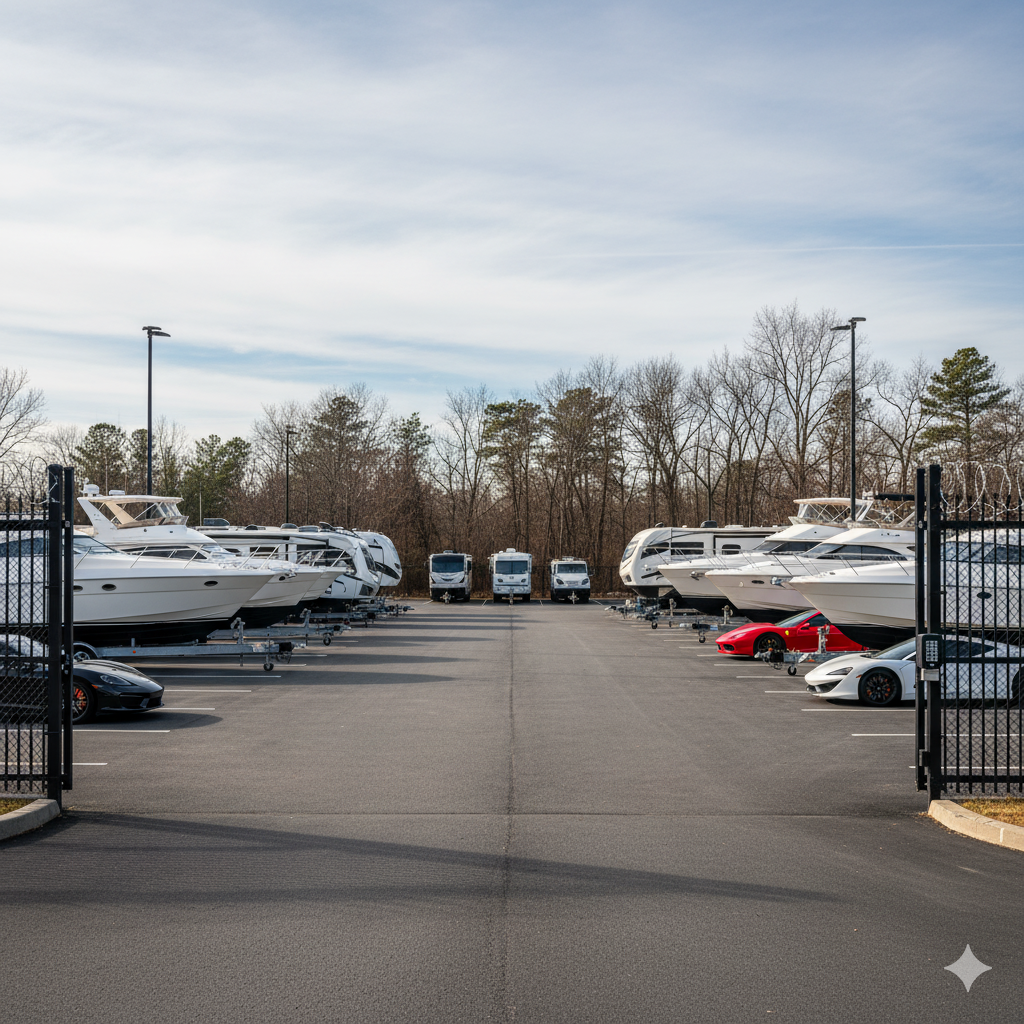
Outdoor storage is the most common option on Long Island, and for a lot of boat owners, it works fine — especially when paired with proper winterization and quality shrink wrapping. It’s more accessible, generally more affordable, and for boats that are well-maintained and modestly valued, it’s a reasonable approach.
But “outdoor storage” covers a wide range of actual conditions. A secured, gated yard with surveillance cameras and proper drainage is a fundamentally different product from an open lot with a chain-link fence. When you’re evaluating outdoor storage, the facility’s security infrastructure matters as much as the price per foot. A boat sitting exposed in an unsecured lot is a theft and vandalism risk that no shrink wrap addresses.
The other honest reality of outdoor storage on Long Island is the weather. Nor’easters are not rare events here — they’re a seasonal expectation. Anyone who was on the Island during Superstorm Sandy understands what it looks like when a boat isn’t adequately protected. The same forces that made Sandy catastrophic operate at a smaller scale every winter: wind, water, freeze-thaw cycles, and salt air.
Shrink wrapping is one of the most common points of confusion in the outdoor storage conversation, and it’s worth addressing directly. A properly applied shrink wrap does real work — it keeps precipitation off the boat, reduces UV exposure on the surfaces it covers, and when done correctly with ventilation ports, it limits moisture buildup inside. For a lot of Long Island boat owners, it’s a standard part of the fall haul-out process, and it’s not a bad one.
What shrink wrap doesn’t do is regulate temperature. It doesn’t stop condensation from forming on cold surfaces inside the wrap when temperatures swing. It doesn’t protect onboard electronics from humidity cycling. And it doesn’t make a poorly secured outdoor lot any safer. Shrink wrap is a supplement to good storage practice — it’s not a substitute for it.
The other thing to know is that shrink wrap quality varies considerably. A wrap that’s applied without proper ventilation can actually trap moisture inside and create conditions that accelerate mold and mildew growth — the opposite of what you’re paying for. If you’ve ever pulled a boat out of winter storage and found mildew on the upholstery despite a full shrink wrap job, that’s likely what happened.
At Legacy Motors and Marine, our outdoor storage is in a secured, gated facility and includes shrink wrapping services. The goal is to make sure that if outdoor storage is the right fit for your vessel, it’s done correctly — not just covered and forgotten until spring.
Most comparison guides end with generic advice that doesn’t actually help. Here’s a more practical framework for thinking through the decision.
Start with your boat’s value and what’s onboard. A vessel in the $15,000 range with basic electronics and a hull you’re not planning to sell soon is a different calculation than a $200,000 yacht with a full electronics suite and interior materials that respond badly to moisture. The higher the value and the more sophisticated the systems, the stronger the case for climate-controlled indoor storage — not because it’s the premium option, but because the cost of what you’re protecting dwarfs the difference in storage cost.
Next, think about your storage duration. Long Island’s boating season runs roughly May through October, which means boats are sitting in storage for five to seven months out of the year. That’s a long time for cumulative damage to build up quietly. A boat stored outdoors for two months in a mild climate is a different situation than a boat sitting in a Long Island winter from November through April.
Finally, consider what services you’ll need during and after storage. Winterization, detailing, electronics work, and spring commissioning are all part of the full picture. A storage facility that can handle those things on-site means less coordination, fewer transport risks, and a boat that’s genuinely ready when the season starts — not one that needs three separate appointments before it hits the water.
We offer both indoor and outdoor storage, which means we’re not trying to push you toward one format because it’s all we have. We also handle marine electronics, detailing with marine-specific products, and concierge pickup and delivery — so the decision about storage format doesn’t have to involve finding multiple vendors. Whatever your vessel needs, it can happen in one place.
We’re based at 1201 NY-112 in Port Jefferson Station, which puts us within easy reach of the North Shore boating community — Port Jefferson Harbor is less than two miles away — and we serve boat owners across Nassau and Suffolk Counties. We’re collectors ourselves, which means we understand what it means to own something that’s more than just a vehicle. That shapes how we approach every vessel we store.
The indoor versus outdoor storage question doesn’t have a single right answer — but it does have a right answer for your boat, your budget, and your situation. The key is making that call deliberately rather than defaulting to whatever’s most familiar or cheapest on the surface.
Long Island’s winters are real. The salt air is real. A five-to-seven-month storage season is a long time for the wrong environment to do quiet damage. Whether that points you toward climate-controlled indoor storage or a well-managed outdoor yard with proper winterization, the decision is worth thinking through before haul-out season is already underway.
If you’re working through that decision and want to talk it over with someone who actually knows boats, reach out to Legacy Motors and Marine. We’ll help you figure out what your vessel actually needs — and make sure it’s ready when the season starts.
Article details:
Share:
Continue learning: