
From outdoor lots to climate-controlled indoor bays, here's what you need to know before choosing where your boat spends the off-season.
Share:

Summary:
The Long Island boating season runs roughly five to six months. That means for the other half of the year, your boat isn’t on the Great South Bay or out past Port Jefferson Harbor — it’s sitting somewhere, hopefully in good hands. Choosing where it sits is one of the most consequential decisions you make as a boat owner, and most people don’t give it nearly enough thought until something goes wrong. This guide covers every major storage option, what each one actually protects against, and what to look for in a facility before you hand over the keys.
When people say “boat storage,” they’re usually picturing one of two things — either a boat sitting outside under a tarp, or a boat parked inside a building. But the real picture is more detailed than that, and the differences between options matter a lot more than most people realize. Understanding what each type actually does — and doesn’t — protect against is the first step toward making a decision you won’t regret in spring.
The broad categories are outdoor storage, covered outdoor storage, indoor non-climate-controlled storage, and indoor climate-controlled storage. There’s also wet slip storage, dry land marina setups, and home driveway storage. Each comes with a different cost structure, a different level of protection, and a different set of tradeoffs. Let’s work through them honestly.

An indoor boat storage facility, at its most basic, puts a roof and four walls between your boat and the elements. That alone is a meaningful upgrade over outdoor storage — no UV exposure, no wind-driven rain, no snow load on your cover, no nor’easter testing the limits of your shrink wrap. For most of Long Island, where winters bring genuine freeze-thaw cycles and salt air is a year-round reality, indoor storage is the most protective option available.
But not all indoor storage is the same, and this is where a lot of boat owners get tripped up. A converted warehouse with a roll-up door is technically “indoor storage.” So is a purpose-built, climate-controlled facility with humidity management, battery tender systems, and security infrastructure. They are not equivalent.
The distinction that matters most — and that most facilities don’t even mention — is humidity control. Temperature control keeps your boat from freezing. Humidity control is what actually prevents the slow, invisible damage that accumulates over a Long Island winter: corrosion on metal fittings, mold growth in cabin upholstery, electronics failure, and the kind of deterioration that doesn’t announce itself until you’re trying to sell the boat or use it after a long storage period. Salt air doesn’t stop being salt air just because your boat is indoors. If the facility isn’t actively managing humidity, the air inside that building still carries the same corrosive load as the air outside.
A quality indoor boat storage facility should also include battery tender systems as a standard feature, not an add-on. Dead batteries are one of the most common complaints when boats come out of storage in spring — and they’re entirely preventable. Beyond that, look for controlled access with documented entry logs, 24/7 monitoring, and the option for periodic maintenance checks during the storage period. A trained eye during the off-season can catch a developing issue — a seeping through-hull, a corroding fitting — before it becomes an expensive emergency in April.
Our Port Jefferson Station facility was built specifically for this purpose. Not converted from a warehouse. Designed from the ground up to store high-value vessels and exotic vehicles, with climate control that manages both temperature and humidity, battery tender systems included in every bay, and security that goes well beyond a camera in the parking lot.
Outdoor storage — uncovered, on a lot — is the lowest-cost option and the least protective. Your boat sits exposed to UV, rain, wind, and whatever a Long Island winter decides to throw at it. Shrink wrap helps, and it’s widely used, but it has real failure modes: UV degradation over a full winter, cover failures during nor’easters, and moisture accumulation underneath if the wrap isn’t properly vented. For lower-value vessels where the cost of premium storage doesn’t pencil out, outdoor storage with proper shrink wrap is a reasonable choice. For anything you’ve put serious money into, it’s a gamble.
Covered outdoor storage — a roof but no walls — is a step up. You’re protected from direct precipitation and most UV exposure. But wind-driven rain, salt spray, and temperature swings still reach the boat. It’s a middle-ground option that works well for trailerable powerboats in the 20-foot range where the owner wants some protection without the cost of full indoor storage.
Dry stack storage, sometimes called hi-and-dry, is a marina-based system where your boat is stored on racks inside a large open structure and launched by forklift when you want to use it. It’s convenient, keeps the hull out of the water (which eliminates galvanic corrosion and biofouling), and works well for powerboats up to roughly 26 feet. The tradeoff is that you’re dependent on the marina’s schedule and equipment for every launch and retrieval, and the storage environment is typically not climate-controlled.
Wet slip storage — leaving your boat in the water year-round or for extended periods — is common in warmer climates but genuinely problematic in the Northeast. Freezing temperatures, ice damage, and the constant exposure to salt water make year-round wet storage a poor choice for most Long Island boat owners. Seasonal wet slips during the active boating season are a different matter, but as a storage strategy, it’s the option with the most risk and the least protection.
Home driveway or garage storage costs nothing ongoing, but it comes with its own set of real constraints. Many Nassau County communities and HOAs either prohibit or significantly restrict storing boats on residential property. And even where it’s allowed, the lack of professional oversight, battery maintenance, and climate control means the boat is essentially on its own for the off-season.
Want live answers?
Connect with a Legacy Motors & Marine expert for fast, friendly support.
Long Island’s storage market includes everything from general self-storage lots that happen to accept boats to full-service marine facilities with decades of history. The range is wide, and the differences aren’t always obvious from a website or a price sheet. Knowing what questions to ask — and what answers should concern you — makes the decision a lot more straightforward.
The most important factors are security specifics, climate control capabilities, what’s included in the base price versus what’s billed as an add-on, insurance coverage on both sides, and whether the facility has genuine expertise with the type of vessel you own.
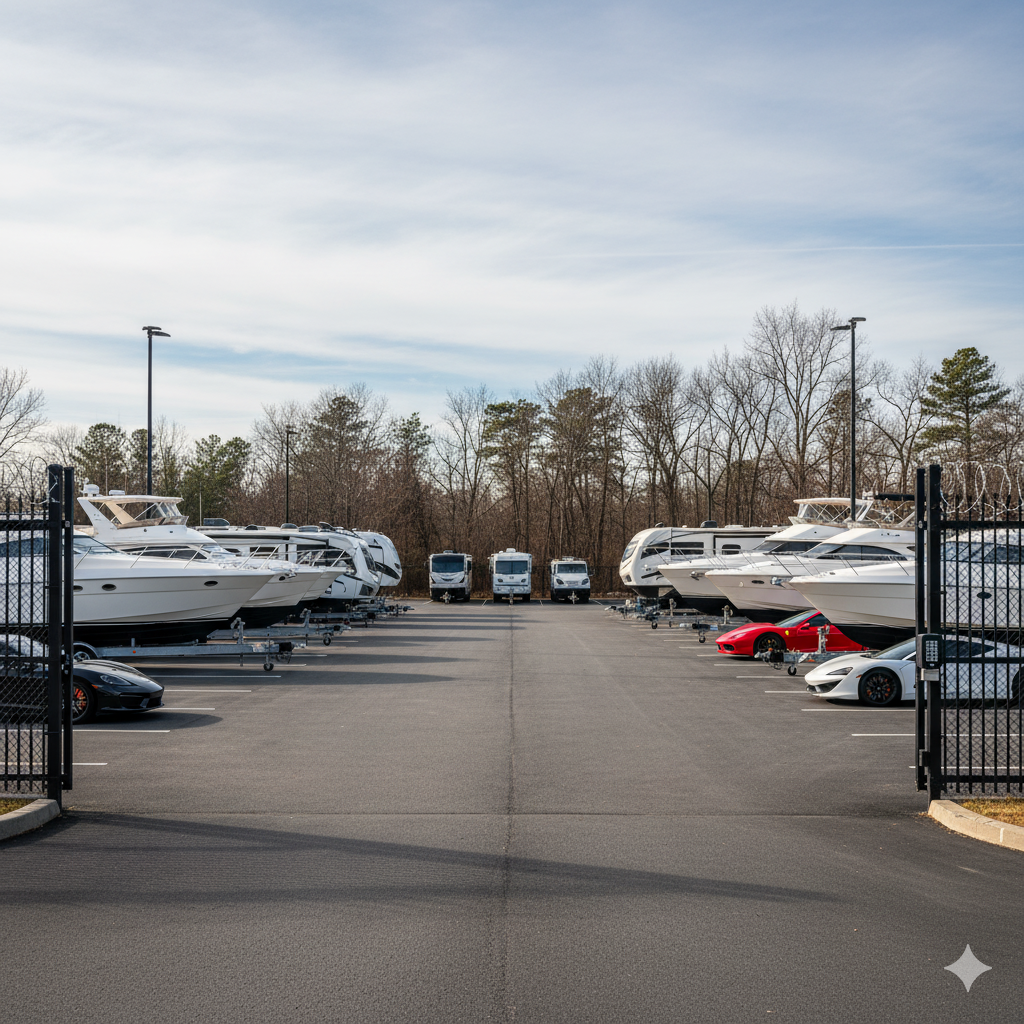
There’s a meaningful difference between a facility that stores boats and a vehicle storage facility that specializes in high-value assets. The difference isn’t just marketing language — it shows up in the physical infrastructure, the staff’s approach, and the day-to-day decisions made about how your vessel is handled.
A general storage lot treats your boat like cargo. A facility built around high-value vehicles treats it like what it is — something that cost real money, requires specific care, and will reflect the quality of its storage when you go to use it or sell it. The questions we ask when you drop it off are different. The way we position and support the vessel is different. The attention to what’s happening during the storage period is different.
We’re collectors ourselves. We store our own exotic vehicles and boats in the same facility using the same standards we apply to every client’s asset. That’s not a tagline — it’s the actual reason this facility exists. When you own something you care about, you want it stored somewhere run by people who understand that feeling from the inside, not just as a business proposition.
That collector perspective also shapes the range of services available under one roof. Storage, precision detailing, ceramic coating, marine electronics installation, and window tinting are all available without your vessel ever leaving the facility. For Long Island boat owners who want to come out of storage with a boat that’s not just functional but genuinely ready for the season — clean, protected, and dialed in — that matters. No other local facility in the Port Jefferson area offers this combination.
The security infrastructure at our facility reflects the same mindset. We maintain twenty-four-hour video surveillance with multiple camera angles, controlled access with authorization codes that are changed regularly, reinforced construction, commercial-grade locks, a professionally monitored alarm system, and detailed access logs. We also carry comprehensive facility insurance and require proof of your vessel’s insurance before storage begins — creating a dual layer of coverage that generic storage lots simply don’t offer.
One question that comes up constantly is whether indoor storage is actually worth the extra cost. The honest answer depends on what you’re storing. For a high-value vessel — a luxury yacht, a well-equipped center console, anything with significant electronics or finish work — the math usually favors indoor storage when you factor in what one bad winter of outdoor storage can cost in repairs, detailing, and electronics replacement. The damage from humidity, salt air, and freeze-thaw cycles is cumulative and often invisible until it isn’t.
Another common question is about access — specifically, whether you can get to your boat when you need it. We offer concierge pickup and delivery for storage clients, which means you don’t have to manage the logistics of moving a large vessel yourself. For owners of larger yachts, that convenience is significant.
People also ask about what happens if something goes wrong during storage. This is where insurance specifics matter. We carry comprehensive coverage, and we require proof of your vessel’s insurance as a condition of storage — so both sides are protected. That’s a different standard than a general lot that accepts liability only for the most limited scenarios.
A question specific to Long Island boat owners: what about the salt air even when the boat is indoors? It’s a fair concern. Long Island’s proximity to the water means salt-laden air is a real environmental factor year-round, not just during active use. That’s exactly why humidity control — not just temperature control — is a non-negotiable feature of our facility. Managing the humidity level inside the storage environment neutralizes the corrosive effect of salt air on metal fittings, electronics, and structural components. It’s the detail most facilities don’t mention because most facilities don’t offer it.
Finally, people ask about vessel size. Our facility accommodates yachts up to 45 feet indoors — a capability that rules out most of the alternatives for larger vessel owners who want true climate-controlled protection. Larger boats are often pushed into outdoor storage by default simply because no suitable indoor option exists nearby. We built the facility so that wouldn’t be the limiting factor.
The storage decision is easy to defer — until spring arrives and the boat tells you exactly how that decision played out. On Long Island, where the off-season is long, the weather is serious, and salt air is a constant, the facility you choose does real work over those six or seven months.
The right choice depends on your vessel, your budget, and what you expect to find when you pull the cover off in May. But if you own something worth protecting, the gap between adequate storage and genuinely good storage is worth understanding before you commit to another season of hoping for the best.
If you have questions about what your specific vessel needs or want to see what a purpose-built climate-controlled facility actually looks like, we’re a straightforward conversation away.
Article details:
Share:
Continue learning: