
Most boat owners don't know what a full detail actually covers. This guide breaks it down from hull to interior — so you know exactly what you're paying for.
Share:

Summary:
Most people use the word “detailing” the way they use the word “cleaning” — loosely, interchangeably, without much thought about what it actually means. But when it comes to your boat, the difference between a wash and a real detail is the difference between maintaining your vessel and slowly watching it degrade.
Long Island’s saltwater environment doesn’t give you much margin for error. The Great South Bay and Long Island Sound are hard on gel coat, hard on teak, and hard on anything left unprotected. This guide breaks down what a proper boat detail actually covers — so you know what to ask for, what to expect, and what to watch out for.
A basic wash removes loose salt, dirt, and debris. That’s useful after a day on the water, but it doesn’t address oxidation, biological growth, UV damage, or the moisture that accumulates inside enclosed cabin spaces. A proper boat cleaning service goes further — it’s a structured process that works through the vessel systematically, treating different surfaces with the right products for each one.
The starting point for any real detail is an assessment. Before anything gets applied, we take a thorough look at the gel coat condition, teak wear, interior moisture levels, and any problem areas to understand what we’re actually working with. Condition-based evaluation is what separates a professional detail from someone who shows up with a buffer and a bucket.

The hull takes the most abuse. Salt, UV exposure, algae, and waterline staining all accumulate over the course of a season — and in Long Island’s saltwater environment, that process moves faster than most owners expect. Oxidation on unprotected gel coat can begin visibly within a single season.
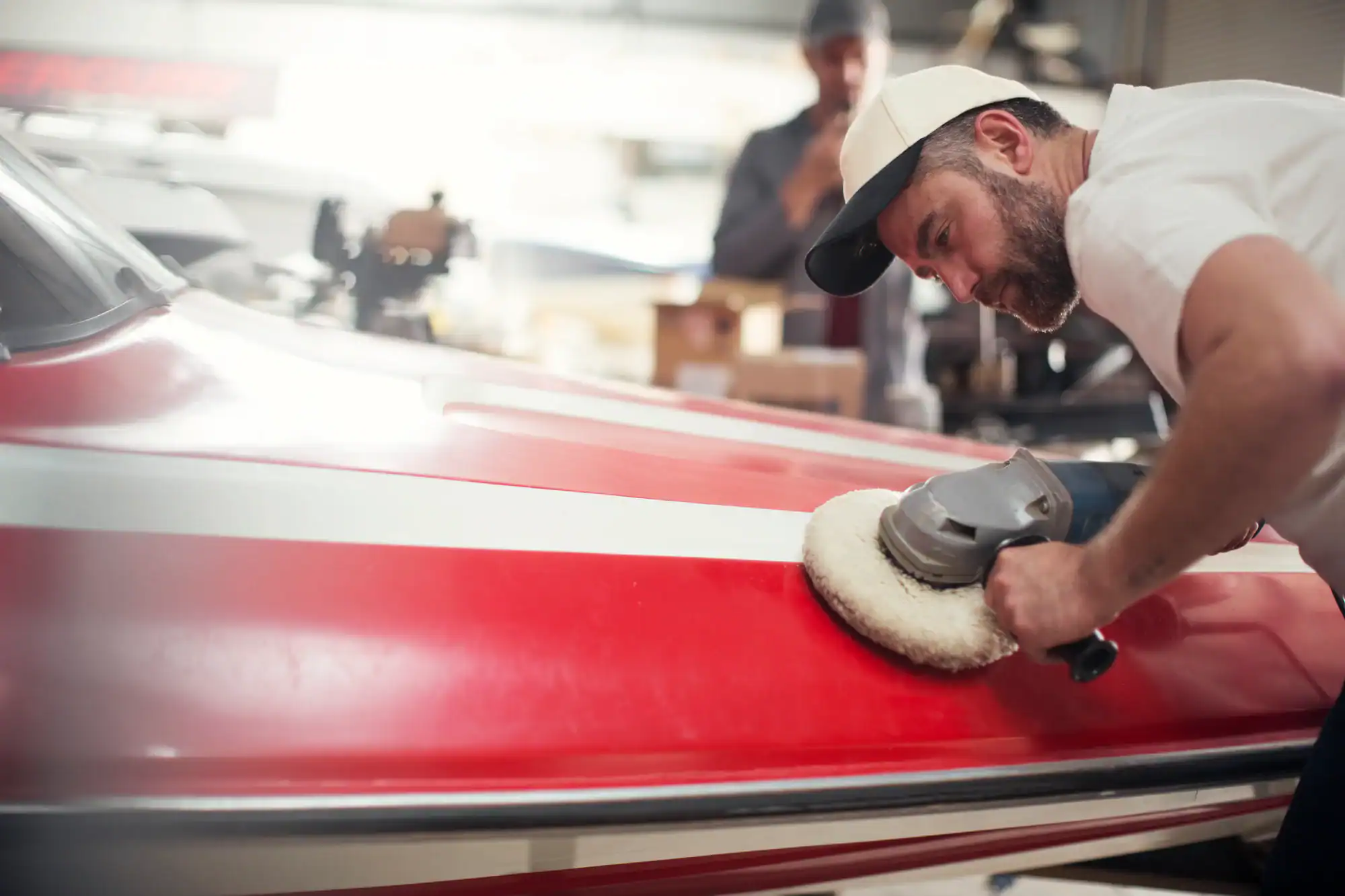
Left alone, oxidation doesn’t just look bad; the surface becomes chalky, porous, and structurally compromised. Removing it isn’t a one-step job. It requires a two-step correction process — a compound pass to break down the oxidized layer, followed by a polish to restore clarity and gloss. Applying wax over oxidized gel coat without correcting first is one of the most common mistakes in DIY boat care. It seals the damage in rather than addressing it, and the surface will look dull again within weeks.
Black streaks are another issue that comes up constantly with Long Island boat owners. Those dark vertical runs down the hull are caused by tannins, algae, and oxidation runoff — they don’t respond to regular soap, and scrubbing them harder usually just spreads them. The right treatment involves specific hull cleaners formulated for marine surfaces, not automotive or household products.
After correction comes protection. Traditional marine wax provides a few months of coverage at best. Marine-grade ceramic coatings bond molecularly with the gel coat surface and last significantly longer — roughly four to six times the longevity of conventional wax. For a boat that spends its summers in the Sound or the Bay and its winters in storage, that difference is meaningful. You’re not reapplying protection every season; you’re protected for years.
Interior detailing tends to get less attention than hull work, but it’s arguably where the most serious problems hide. Long Island summers are humid. Enclosed cabin spaces — especially on boats that sit in slips or get covered between uses — are ideal environments for mold and mildew to take hold. By the time you can see it, it’s already established. By the time it smells, you’ve got a remediation problem, not a cleaning problem.
A proper interior detail addresses moisture, not just surface dirt. We treat vinyl upholstery with products that condition the material and inhibit biological growth, clean carpet and soft surfaces down to the backing, and make sure the bilge area and any enclosed storage spaces are dried and treated. We also check areas that don’t get opened often — under cushions, in lockers, behind panels — because that’s where mold starts.
Teak is its own category. It’s one of the most high-maintenance surfaces on a boat, and it requires cleaners, brighteners, and sealers that are specifically formulated for teak — not general deck cleaners, and certainly not anything designed for automotive interiors. Treating teak correctly preserves both its appearance and its structural integrity. Treating it with the wrong products can strip the natural oils that keep the wood from drying, cracking, and graying prematurely.
The sequence matters here too. Interior cleaning should happen before exterior wax is applied — not after. If we wax the hull first and then work inside the boat, we risk contaminating freshly protected surfaces with foot traffic, product overspray, or cleaning runoff. A professional detail follows a logical order that protects each stage of the work.
Want live answers?
Connect with a Legacy Motors & Marine expert for fast, friendly support.
This isn’t a generic point about saltwater being hard on boats. Long Island’s specific combination of conditions — the Great South Bay’s shallow, high-particulate brackish water, the choppier salt exposure of the Sound, the intense summer UV, and the freeze-thaw cycles that come with Northeast winters — creates an environment that accelerates surface degradation faster than most freshwater or southern markets.
A boat that looks fine in May can show visible chalking, waterline staining, and black streaks by August without proper protection in place. The salt doesn’t just sit on the surface — it gets into micro-cracks in the gel coat, and when temperatures drop and moisture expands, those cracks get worse. Pre-winter detailing isn’t cosmetic maintenance. It’s damage prevention.
One of the most common questions we hear is whether it matters what products are used, as long as the result looks clean. It matters enormously — and the consequences of using the wrong products on a boat aren’t always visible right away.
Car wax is the most frequently cited example. It’s widely available, familiar, and used by well-meaning boat owners who figure wax is wax. But automotive wax is formulated for painted metal surfaces in environments that don’t involve constant salt exposure, UV intensity, or water immersion. Applied to marine gel coat, it breaks down quickly, offers minimal protection against the specific stressors a boat faces, and in some cases leaves a residue that makes proper marine products harder to bond with afterward.
The same principle applies across every surface on the boat. Marine vinyl requires different conditioners than automotive vinyl. Teak requires its own product line. The hull’s gel coat is not the same as automotive clear coat — it’s a different material with different porosity, different UV sensitivity, and different requirements for correction and protection. A yacht detailing service that treats every surface like a car door panel is going to produce results that look acceptable for a few weeks and then fall apart.
We use marine-specific products across every stage of the detailing process. That’s not a marketing line — it’s a practical decision that affects how long the work holds up in the conditions Long Island boats actually face. When someone asks why their boat looks dull again three months after a detail somewhere else, the answer is usually the products and the process, not the boat.
The standard guidance for saltwater boats is a thorough detail at minimum twice a year — once before launch in the spring, and once before winter storage in the fall. In practice, for boats that see heavy use through the summer, a mid-season wash and maintenance treatment is worth adding to that schedule.
The fall detail is the one that gets skipped most often, and it’s the one that matters most. Whatever salt, UV damage, biological growth, and oxidation accumulated over the season doesn’t pause when the boat goes into storage — it keeps working on the surfaces through the winter. A boat that goes into storage without a proper fall detail in October comes out in April with more oxidation, more staining, and more interior mold than it went in with.
For Long Island boat owners who store their vessels through the winter, the fall detail is also the moment to assess what the season did to the protective coating and decide whether a ceramic coating application makes sense before storage. A freshly coated boat going into climate-controlled indoor storage is in a fundamentally different position in the spring than one that went in with no protection and sat through a Northeast winter.
The spring detail, by contrast, is about removing what storage itself introduced — dust, any moisture that got in, and the surface oxidation that continues even in storage — and getting the vessel ready to perform and look right from the first day it’s back in the water. That’s when a full assessment of what the winter did to the gel coat, teak, and interior surfaces is worth doing before any product is applied.
A real boat detail is a systematic process that works through every surface on the vessel — hull assessment, oxidation correction, protective coating, interior moisture control, teak care — in the right order, with the right products. It’s not a wash with extra steps. And in Long Island’s saltwater environment, the difference between doing it right and doing it halfway shows up faster than most owners expect.
If your boat is heading into storage, coming out of it, or just showing the kind of wear that a season on the Sound or the Bay leaves behind, we’re here to help. Legacy Motors and Marine works with boat owners across Nassau and Suffolk County. If you want to know what your vessel actually needs, we’re happy to start with a proper assessment.
Article details:
Share:
Continue learning:
