
Think any good detailer can handle your boat? Here's what actually separates marine detailing from auto detailing — and why the difference matters more than you'd expect.
Share:
Summary:
If you’ve ever wondered whether your trusted auto detailer could handle your boat, you’re not alone. It’s a logical question — they do great work on your car, they’ve got the equipment, and detailing is detailing, right? Not exactly. Marine detailing is its own discipline, with different materials, different products, and techniques that don’t transfer directly from the driveway to the dock. Getting that wrong doesn’t just mean a subpar result — it can mean permanent damage to surfaces that are expensive to restore. Here’s what actually separates a professional marine detailing service from auto detailing, and why it matters for anyone who owns a boat on Long Island.
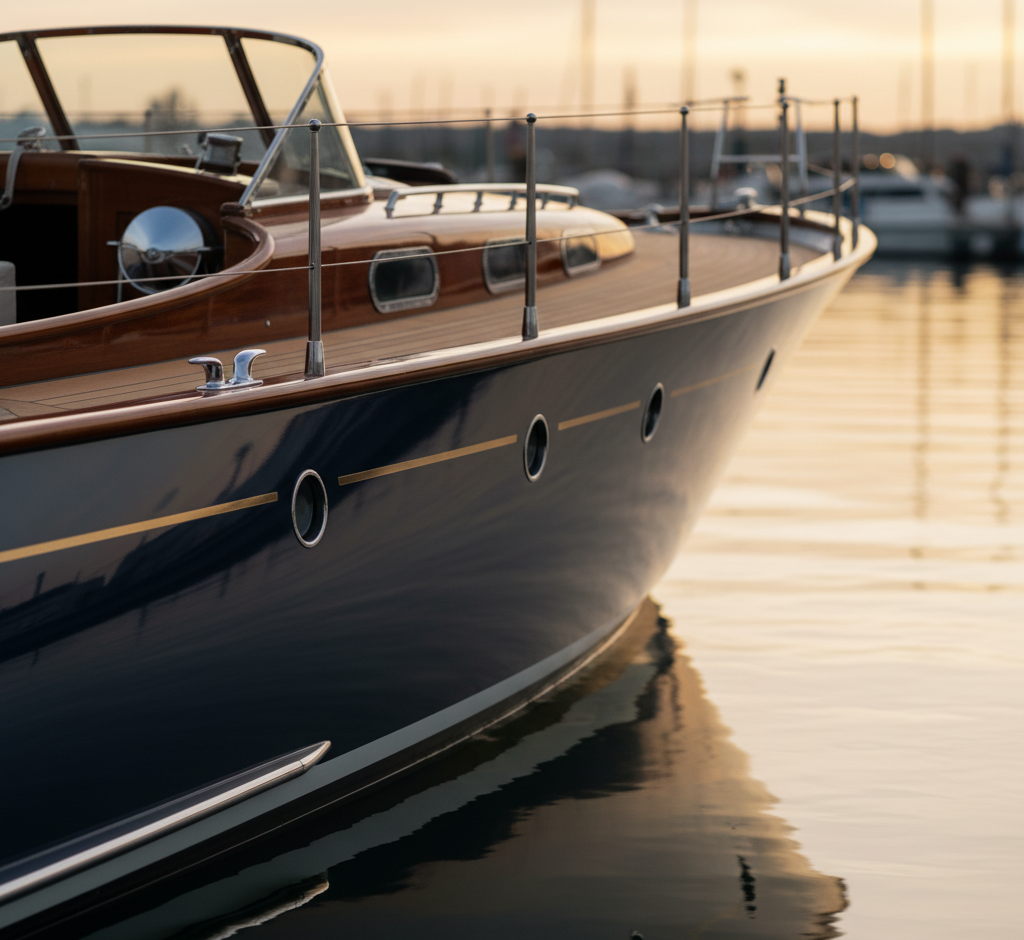
Marine detailing is a comprehensive cleaning, restoration, and protection process designed specifically for boats and watercraft. It goes well beyond a wash and wax — a full professional detail covers the exterior gelcoat, the hull, the interior cabin, upholstery, vinyl, teak surfaces, metal hardware, glass, and often the engine bay and bilge.
What makes it distinct from auto detailing isn’t just the scope — it’s the environment the vessel lives in. Saltwater, UV radiation bouncing off the water’s surface, humidity, and marine growth all create conditions that automotive products and techniques simply aren’t built for. A proper marine detail accounts for all of that, from the products chosen to the order of operations.
This is the part most people don’t know until something goes wrong. The exterior surface of most fiberglass boats is gelcoat — a thick, pigmented resin that’s applied during manufacturing and serves as both the finish and the first line of protection. It looks a bit like automotive paint, but it behaves completely differently.
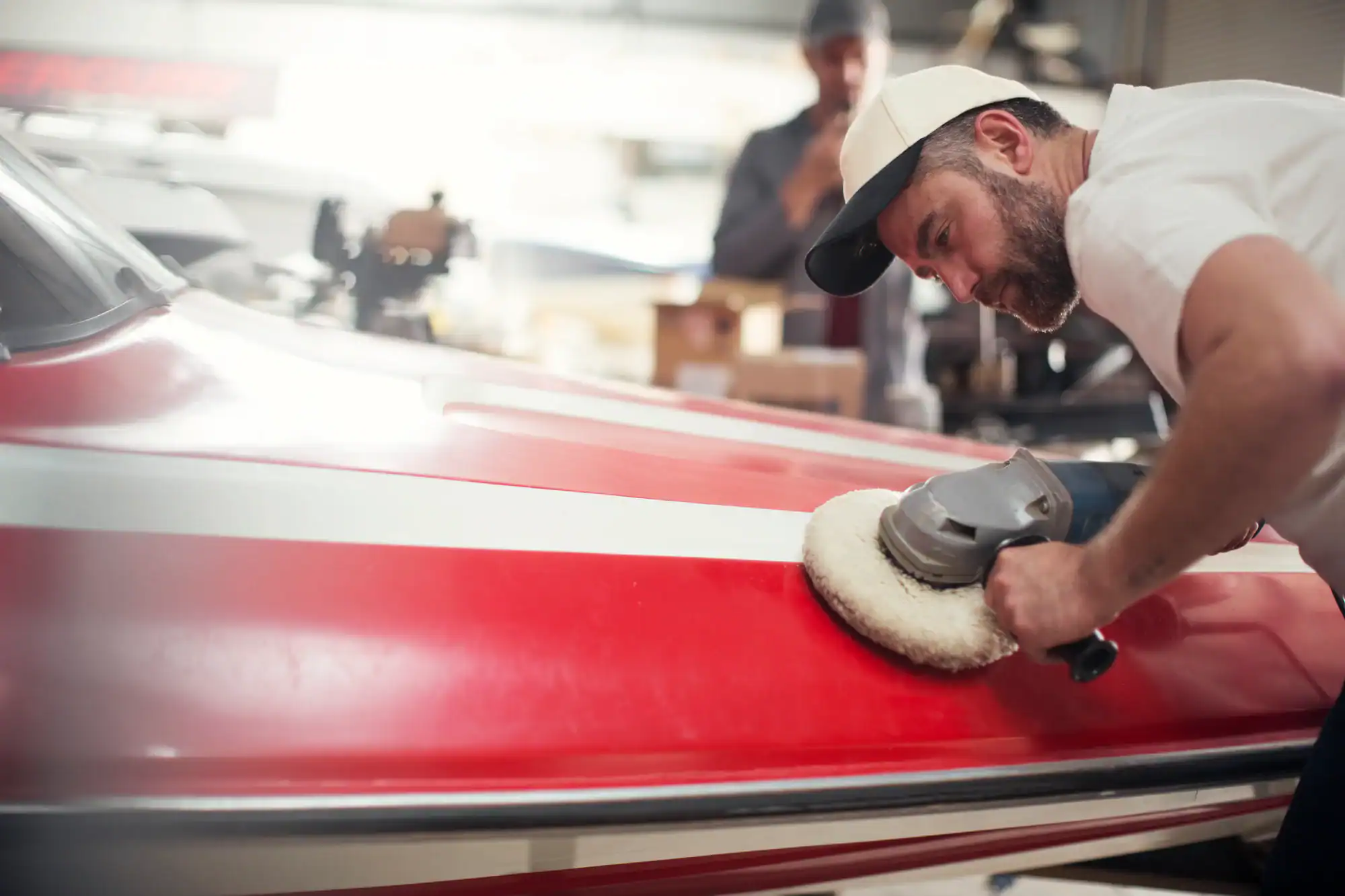
Automotive clear coat is a thin, flexible layer applied over base paint. It’s designed to be worked with specific compounds, polishes, and pads at specific speeds and pressures. Gelcoat is much thicker and more porous, it oxidizes differently, and it responds to correction work in ways that clear coat does not. The compounds that safely remove swirls from a car’s paint can cut too aggressively into gelcoat if used incorrectly. The result isn’t a swirl mark — it’s a dull, hazy patch that may require professional restoration to address.
This isn’t a technicality. It’s the reason that experienced marine detailers train specifically for gelcoat work, use different pad and compound combinations, and approach correction at different machine speeds than they would on a car. When a detailer who primarily works on cars attempts boat work without that background, they’re improvising on a surface where improvisation has real consequences.
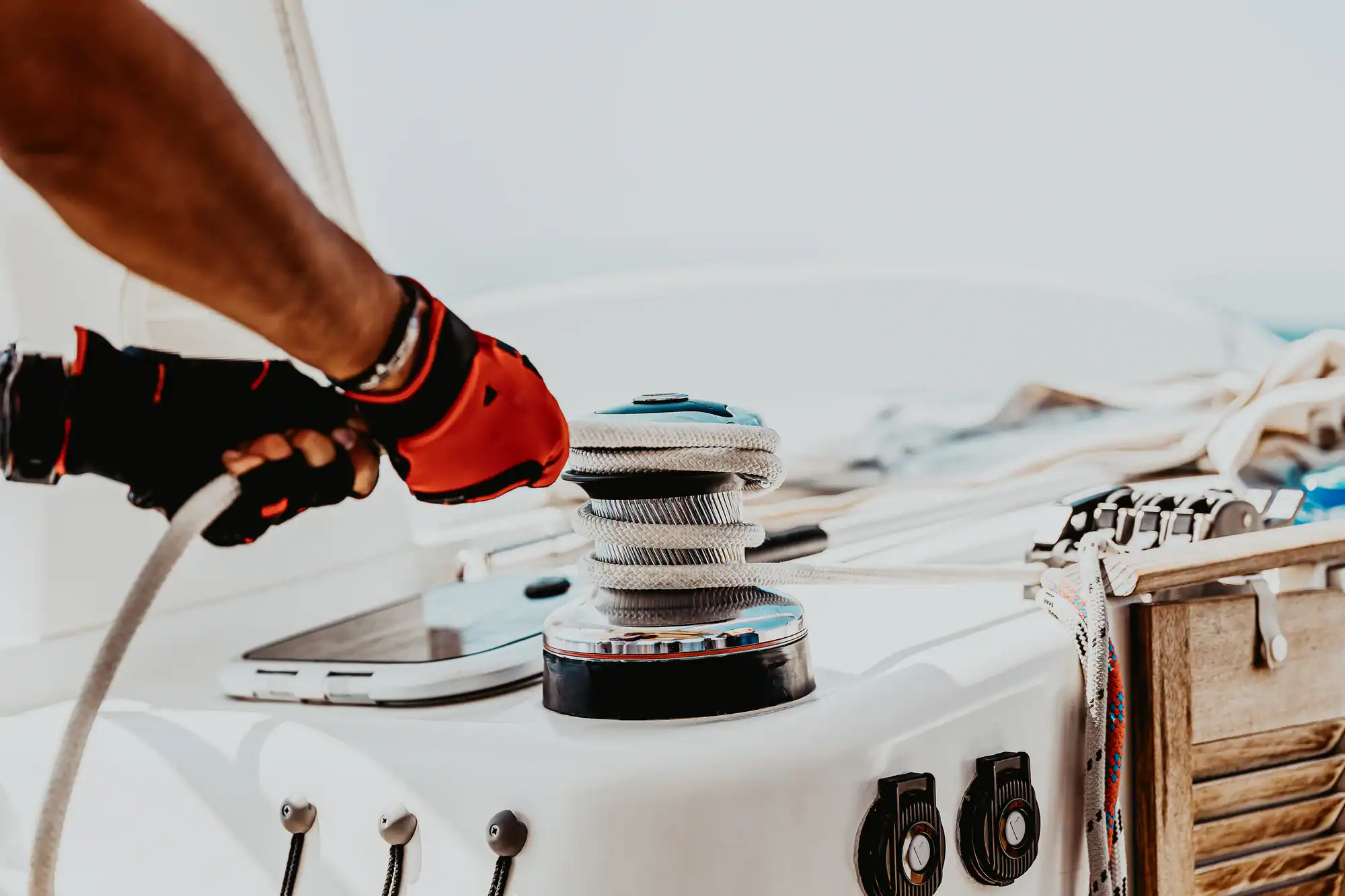
The same logic applies to interior surfaces. Boat interiors use marine-grade vinyl, canvas, and upholstery materials that are formulated to resist moisture and UV in ways that automotive interior materials are not. The cleaning agents and conditioners appropriate for a car’s leather seats aren’t necessarily appropriate for a boat’s vinyl upholstery — and using the wrong product can accelerate breakdown rather than prevent it.
If a detailer uses the same products on boats that they use on cars, that’s a meaningful red flag. Marine environments demand marine-specific formulations. It’s not about brand preference — it’s about chemistry that’s actually designed for the conditions.
A professional marine detailing service follows a process that’s more involved than most boat owners expect. It starts with a thorough condition assessment — understanding what the vessel needs before any product touches the surface. From there, the exterior goes through a full wash with marine-safe soap, followed by decontamination to remove salt deposits, oxidation, waterline staining, and any marine growth that’s accumulated on the hull.
Oxidation removal is often the most labor-intensive part of the exterior work. UV exposure on the water — amplified by reflection off Long Island Sound — breaks down gelcoat faster than most owners realize. A chalky, faded finish isn’t just cosmetic; it means the protective layer is degrading. Addressing it properly requires the right compound, the right pad, and someone who knows how far to take the correction without going through the gelcoat.
After correction comes protection. This is where the choice between wax, a polymer sealant, or a ceramic coating becomes important. Traditional wax breaks down in three to four months under normal boating conditions. On a saltwater boat in a Long Island Sound environment, that timeline can be even shorter. Polymer sealants extend protection to six to twelve months. Professional-grade ceramic coatings, applied in a controlled environment, can protect for two to five years — and our marine-specific ceramic formulations are engineered for saltwater exposure, not just adapted from automotive applications.
Interior work on a full marine detail covers cabin surfaces, upholstery and vinyl cleaning and conditioning, carpets, consoles, and electronics surfaces. Moisture control is a significant part of this — mold and mildew in boat interiors are common problems in Long Island’s humid summers, and they don’t resolve themselves. Teak cleaning and conditioning, metal polishing on stainless steel and chrome hardware, canvas and bimini care, and glass treatment round out a complete detail. It’s a full-vessel process, not a surface-level cleanup.
Want live answers?
Connect with a Legacy Motors & Marine expert for fast, friendly support.
Yacht detailing follows the same principles as marine detailing broadly, but the scale, the materials, and the expectations are different. Larger vessels have more surface area to address, more complex interior spaces, and often more specialized materials — teak decking, custom upholstery, high-end electronics, and exterior finishes that require careful handling.
For yacht owners, the financial stakes of getting this wrong are proportionally higher. A poorly executed polish on a 50-foot yacht’s gelcoat isn’t a minor inconvenience — it’s a restoration job. The right provider for yacht detailing service is one who has demonstrable experience with larger, higher-value vessels and approaches the work with the same precision they’d apply to any significant asset.
For most Long Island boat owners, the answer is yes — and the reasoning is straightforward once you understand what you’re comparing it to.
Traditional wax provides a temporary barrier against UV, salt, and water. It looks good when freshly applied, but it breaks down quickly in marine conditions. Reapplying it every season is the standard routine for most boat owners. Ceramic coating changes that equation significantly. A professional-grade marine ceramic coating bonds to the gelcoat at a molecular level, creating a durable, hydrophobic surface that repels water, resists salt contamination, and holds up to UV exposure far longer than any wax product.
Our marine ceramic coatings provide up to 18 months of protection with minimal maintenance required — and depending on the product and the vessel’s conditions, full protection can extend to several years. That’s a fundamentally different level of protection, and for a boat that spends time on Long Island Sound, where salt air is a constant and UV reflection off the water is intense, the difference shows up in the condition of the gelcoat over time.
The application process matters as much as the product itself. Ceramic coatings require a controlled environment — consistent temperature and humidity — to cure properly. Applying a ceramic coating outdoors, or in a space where dust and temperature fluctuations are uncontrolled, compromises the bond and shortens the effective life of the coating. Our Port Jefferson Station facility maintains the climate-controlled conditions that ceramic coating application demands, which is part of why the results hold up the way they do.
For yacht owners specifically, ceramic coating is often the most cost-effective protection decision available. The alternative — repeated restoration work on oxidized or damaged gelcoat — is significantly more expensive over time than maintaining a properly coated surface from the start.
The marine detailing market has a lot of auto detailers who also do boats — and a much smaller number of providers who have built their practice specifically around marine work. Telling the difference matters, and there are a few things worth looking for.
The first is product specificity. A detailer who can tell you exactly what marine-grade products they use, and why those products are appropriate for gelcoat versus automotive clear coat, is showing you they’ve done the work to understand the discipline. Vague answers about materials are not the same as genuine expertise.
The second is process transparency. A professional marine detailing service should be able to walk you through what we’re going to do to your vessel before we touch it — what the condition assessment covers, what the correction process looks like, what protection we’re applying and how long it lasts. If a quote comes back without that context, you’re guessing at what you’re actually paying for.
The third is facility and infrastructure. Ceramic coating application, in particular, requires a controlled environment. If a provider is doing this work outdoors or in an uninsulated space, the results will reflect that. A purpose-built facility with climate control is not a luxury detail — it’s a functional requirement for certain services.
We’re collectors ourselves, which shapes how we approach every vessel that comes through our Port Jefferson Station facility. We understand what it means to own something that represents more than transportation — whether that’s a six-figure exotic car or a luxury yacht. That perspective is built into how we handle every detail, from the intake assessment to the final inspection. We also offer concierge pickup and delivery for clients who can’t transport their vessel directly to us, and mobile service to your marina slip or home dock when that’s the more practical option. Long Island’s boating community has high standards — because the conditions here demand it, and because the people who love these boats expect nothing less.
Marine detailing is a separate discipline, not a variation of auto detailing. The surfaces are different, the products are different, the techniques are different, and the consequences of getting it wrong are real. For boat owners on Long Island — where salt air, UV reflection off the water, and humidity are facts of life — professional marine detailing service isn’t a cosmetic choice. It’s how you protect what you’ve invested in.
Whether you’re looking at routine seasonal maintenance, oxidation correction, a full interior deep clean, or a ceramic coating that actually holds up to Long Island Sound conditions, the process and the provider both matter. If you’re ready to talk through what your vessel needs, Legacy Motors and Marine is the place to start.
Article details:
Share:
Continue learning:
