
One service cleans your paint. The other actually fixes it. Here's how to tell which one your vehicle actually needs — and why it matters more than you think.
Share:

Summary:
You wash your car, maybe get it detailed, and it looks great for a couple of weeks. Then the swirls come back. The haze returns. Under direct sunlight or the lights in a parking garage, the paint looks almost worse than before. That’s not a cleaning problem — that’s a paint problem. And no amount of washing or waxing is going to fix it. Understanding the difference between paint correction and basic detailing isn’t about being a car obsessive. It’s about knowing what you’re actually paying for, and whether it’s going to solve your problem or just delay it.
Basic detailing is a cleaning and protection service. It covers washing, decontamination, interior work, and applying a wax or sealant to the paint surface. Done well, it leaves a car looking clean and adds a layer of short-term protection. What it doesn’t do is remove defects. Swirl marks, fine scratches, water spot etching, oxidation — these live inside the clear coat itself. Wax sits on top of the clear coat and temporarily fills those imperfections, which is why a freshly detailed car can look great for a few weeks before the same problems reappear.
Paint correction is a different process entirely. It uses machine polishing with abrasive compounds to physically level the clear coat and eliminate defects — not hide them. The results don’t wash away because the defects are actually gone. It takes significantly more time, more skill, and more equipment than a standard detail, which is why it costs more and why not every shop offers it properly.
If you’ve ever picked your car up from a detail and noticed the swirls were back within a month, you weren’t imagining things. The wax or glaze applied during a standard detail contains fillers and oils that settle into surface scratches and make them temporarily invisible. As that product breaks down from washing, UV exposure, and normal use, the defects underneath become visible again. You didn’t get a bad detail — you got a service that was never designed to fix that problem in the first place.
This is one of the most common points of confusion in the detailing world, and it’s worth being direct about: if your paint has visible swirl marks, haze, or etching, a basic detail will not correct them. It will make the car look better for a short period, but the underlying condition of the paint hasn’t changed.
Dark-colored cars — black, dark navy, charcoal — show paint defects far more clearly than lighter colors. A black exotic with swirl marks under showroom lighting looks significantly worse than the same car with corrected paint. The contrast between a properly corrected dark finish and an uncorrected one is dramatic, and it’s one of the main reasons paint correction is so common among luxury and exotic vehicle owners.
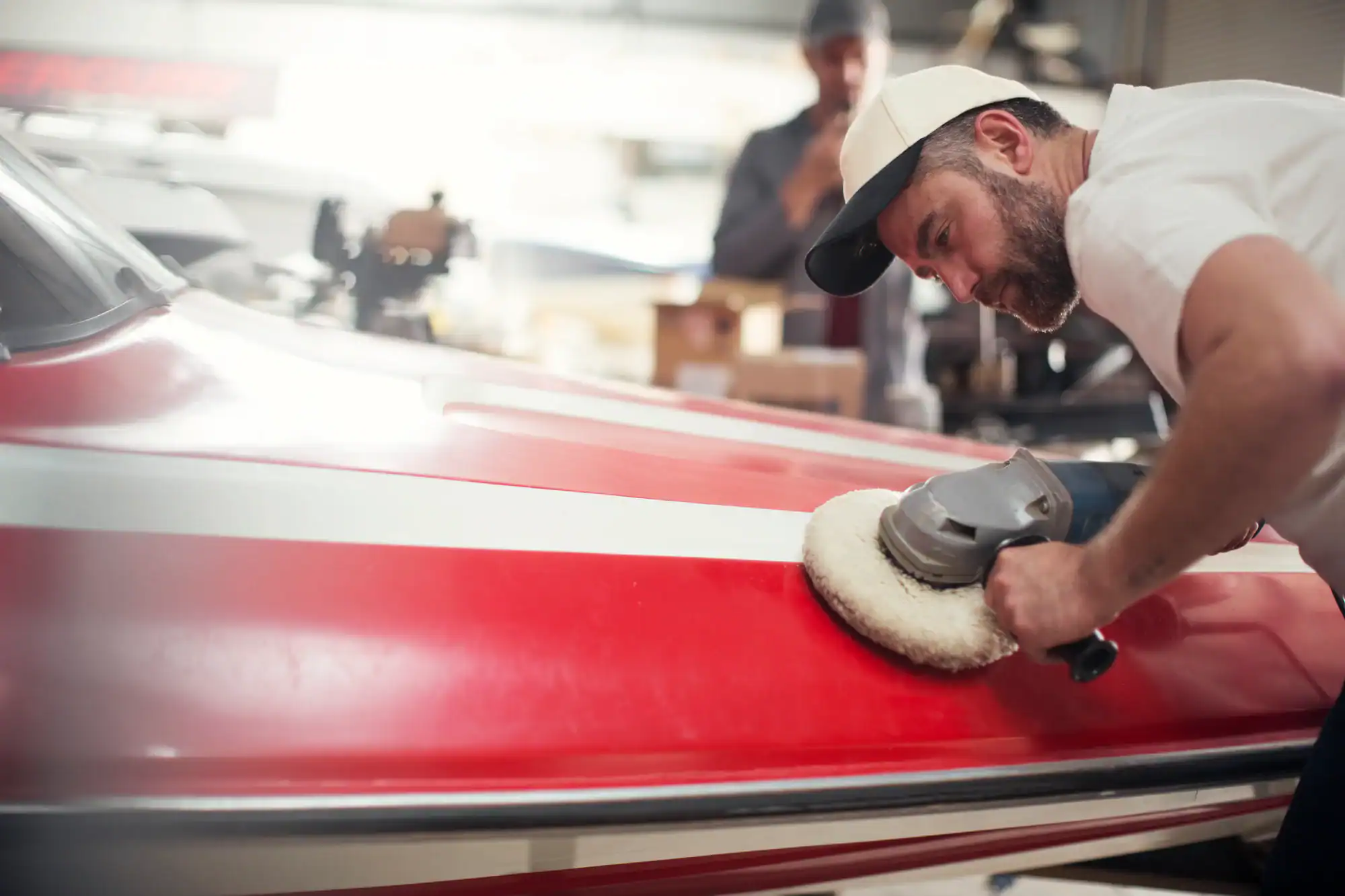
It also matters for boats. Gel coat on fiberglass oxidizes and hazes just like automotive clear coat, and the same principle applies — waxing an oxidized hull makes it look better temporarily, but it doesn’t reverse the oxidation. Multi-stage compound and polish work is what actually restores heavily oxidized gel coat to a clean, reflective surface.
A proper paint correction job starts well before any polishing begins. The first step is a thorough decontamination wash — not just a rinse, but a process designed to remove bonded surface contamination that regular washing leaves behind. This includes iron decontamination to pull out embedded brake dust and ferrous particles from the paint, followed by a clay bar treatment to remove anything still clinging to the surface. Skipping these steps and going straight to polishing is one of the most common shortcuts taken by less experienced shops, and it produces noticeably worse results because contamination left in the paint acts like sandpaper during the correction process.
Before any abrasive compound touches the paint, we measure paint thickness across multiple panels. This step is non-negotiable when working on high-value vehicles. Modern clear coats are thin — typically in the range of 50 to 100 microns — and each stage of correction removes a small fraction of that. Without knowing where you’re starting, it’s easy to over-correct and cause irreversible damage. Paint thickness measurement protects the vehicle and informs which correction approach is appropriate.
The polishing itself is done in stages depending on the severity of the defects. A single-stage correction addresses light swirls and minor surface haze. Two-stage correction handles moderate defects — deeper swirls, light scratches, early-stage water spot etching. Three-stage correction is reserved for more significant damage: heavy oxidation, deep etching, buffer trails from previous poor polishing work. Each stage uses a progressively finer compound and pad combination, and the work is inspected under high-intensity lighting throughout to confirm defects are being fully removed — not just reduced.
The entire process on a full correction can run eight to twelve hours or more depending on the vehicle’s size and condition. That’s not a detail. That’s a restoration.
Want live answers?
Connect with a Legacy Motors & Marine expert for fast, friendly support.
Paint correction and car paint restoration are terms that often get used interchangeably, but they describe slightly different situations. Correction typically refers to removing specific surface defects — swirl marks, light scratches, water spots — from paint that is otherwise structurally sound. Restoration implies a more significant intervention: paint that has oxidized heavily, faded significantly, or degraded to the point where the surface itself needs to be rebuilt before it can be refined.
On boats, this distinction is especially relevant. Gel coat that has been left unprotected and exposed to UV and saltwater for years can reach a point of oxidation where standard polishing alone isn’t enough. Compound work at higher cut levels is required before any finishing polish can produce a clean result. The process is more intensive, takes longer, and requires a careful read of the surface to avoid cutting through the gel coat entirely.
Long Island’s coastal environment is genuinely harder on paint and gel coat than most inland markets. Salt air off Long Island Sound to the north and the Atlantic to the south is a constant presence, especially for vehicles parked near the water or boats kept at a marina. Salt doesn’t just sit on the surface — it works into paint and gel coat over time, accelerating oxidation and contributing to the kind of surface degradation that eventually requires correction rather than maintenance.
Hard water is another factor specific to the area. Long Island’s water supply can leave mineral deposits on paint surfaces that, if not removed properly, etch into the clear coat. Water spots that look like they should rinse off sometimes won’t — because the minerals have already done damage. This is a common complaint from owners who wash their cars regularly and still end up with visible surface defects.
UV exposure compounds all of it. Boats on the water in summer are getting continuous UV radiation with no shade. Vehicles driven on the South Shore or stored in open lots near the water are in a similar position. UV breaks down clear coat and gel coat over time, and the combination of salt, mineral deposits, and UV means the threshold for needing correction arrives sooner for Long Island owners than it does for someone keeping the same vehicle in a garage in a dry inland climate.
This is part of why we work with both automotive and marine clients at our Port Jefferson Station facility — the environmental challenges are the same whether it’s a car or a boat, and the correction approach has to account for them. Marine-specific products matter here. Using generic automotive compounds on gel coat, or ignoring the salt contamination that’s embedded in a vehicle’s paint before starting correction work, produces inferior results regardless of the skill level of the technician.
Yes — and this is one of the most important things to understand if you’re considering ceramic coating for your car or boat. Ceramic coating bonds to the paint surface and hardens over it, creating a durable protective layer. That sounds great, and it is — but it also means that whatever condition the paint is in when the coating goes on is the condition it stays in. Swirl marks, water spot etching, haze — if they’re present when the coating is applied, they get sealed in permanently under a layer that’s difficult to remove.
Applying ceramic coating over uncorrected paint is one of the most common and costly mistakes in the detailing world. Owners spend significant money on a premium coating, and the results are disappointing because the paint underneath wasn’t prepared properly. The coating itself may be flawless — the problem is what’s under it.
Correction before coating isn’t an upsell. It’s the prerequisite that determines whether the coating is actually worth having. A properly corrected surface under ceramic coating produces a finish with mirror-sharp reflections and no visible marring — the kind of result that lasts for years with proper maintenance washing. An uncorrected surface under the same coating still looks like an uncorrected surface, just with more durability.
We perform correction and ceramic coating in sequence at our climate-controlled facility in Port Jefferson Station. The controlled environment matters for coating application — temperature and humidity affect how ceramic coatings bond and cure, and doing this work in an uncontrolled space introduces variables that affect the final result. If you’re investing in a ceramic coating for a vehicle you care about, the environment where it’s applied is part of what you’re paying for.
This same logic applies to boats. Marine ceramic coatings engineered for saltwater environments provide meaningful protection against the conditions Long Island owners face — salt air, UV, hard water mineral deposits. But they have to go on clean, corrected gel coat to perform the way they’re designed to.
If your paint looks clean after a wash but dull or hazy in direct light, you likely need correction. If your gel coat has lost its gloss and looks chalky or faded, you need restoration work before any protective coating will make a meaningful difference. And if you’re planning to apply ceramic coating to anything you care about — car or boat — correction isn’t optional.
Basic detailing has its place. It’s the right service for paint that’s already in good shape and just needs to be cleaned and maintained. But it’s not a substitute for correction, and understanding that distinction saves you from spending money on a service that won’t solve your actual problem.
If you’re not sure where your vehicle or vessel stands, that’s a reasonable place to start. We work with exotic car owners, luxury vehicle owners, and serious boaters across Nassau and Suffolk County — and we’re happy to give you a straight answer about what your paint actually needs before you commit to anything.
Article details:
Share:
Continue learning:
